AI to accelerate teaching and automate grading and school management.
An editorial platform for schools and universities. AI-authored exams, review with per-student calibration — not a generic detector, and automatic grading — all in one place.
Schools haven't changed. AI has.
Every teacher grades differently.
On an integration-by-parts exam, some teachers value only the final result; others hand out partial credit for each step. Without shared criteria, each class gets a different grade.
65% of undergrads admit cheating at least once · McCabe / ICAI
Only 46% of a teacher's day is actually teaching.
Grading four classes, uploading scores, handling appeals, replacing leaked exam banks. Time in front of students ends up under half the working day.
46% teaching · 54% non-instructional work · EdWeek 2022
Students use AI before teachers do.
You no longer know whether a student or a model wrote the answer. Without integrity standards, the evaluation breaks down and the labor market doesn't get what it expects.
88% of students use AI on assessments · HEPI 2025
Three pillars. One flow.
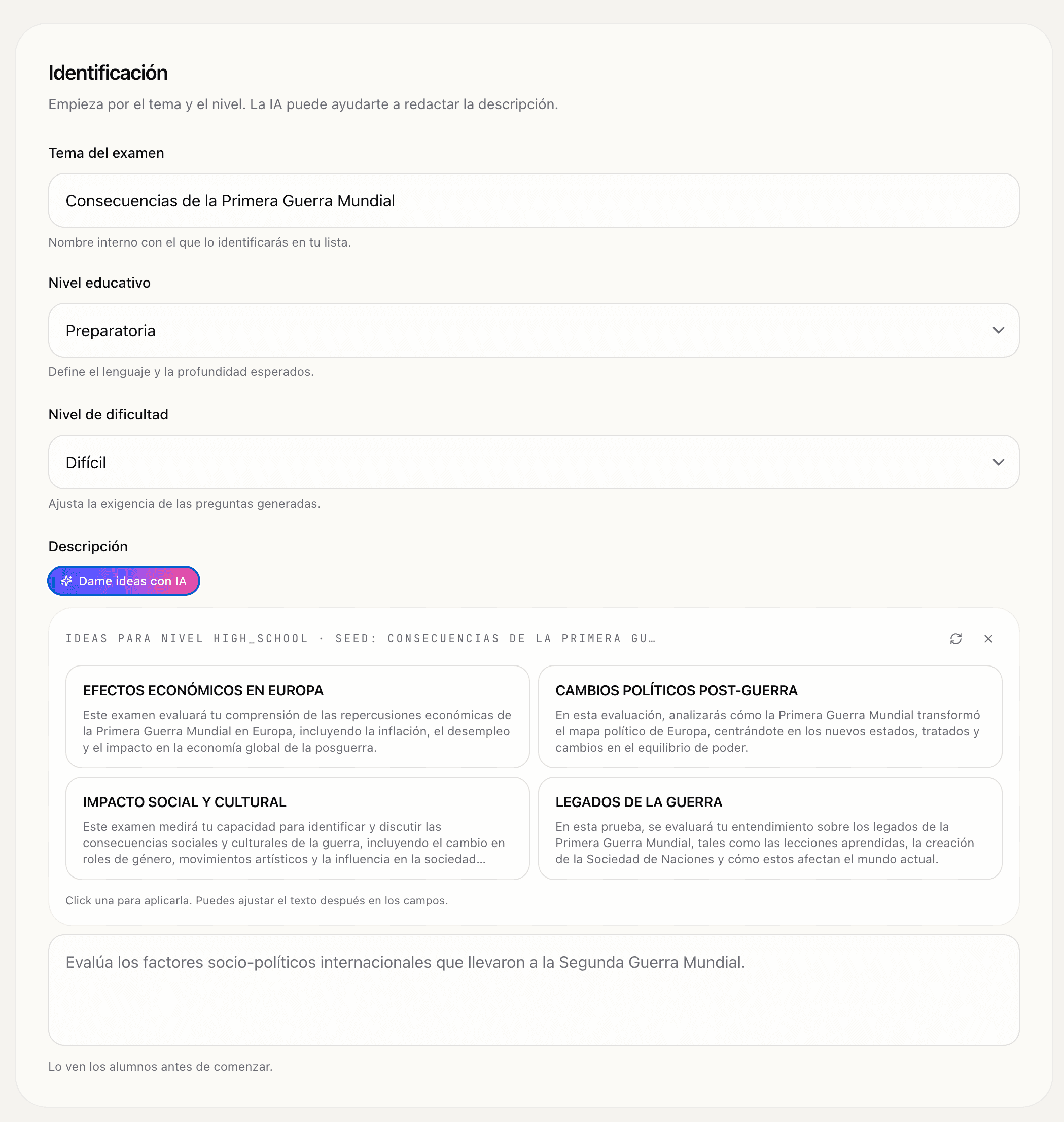
Before the first question, AI already understands your exam.
You set topic, level, and difficulty. AI proposes ideas tuned to your subject — economic impact, social shifts, political consequences — and you pick what works. Before writing a single question the exam already has topic, description, and focus. Per-student unique versions from setup.
- Topic · level · difficulty
- AI ideas · tuned to your subject
- Per-student unique versions
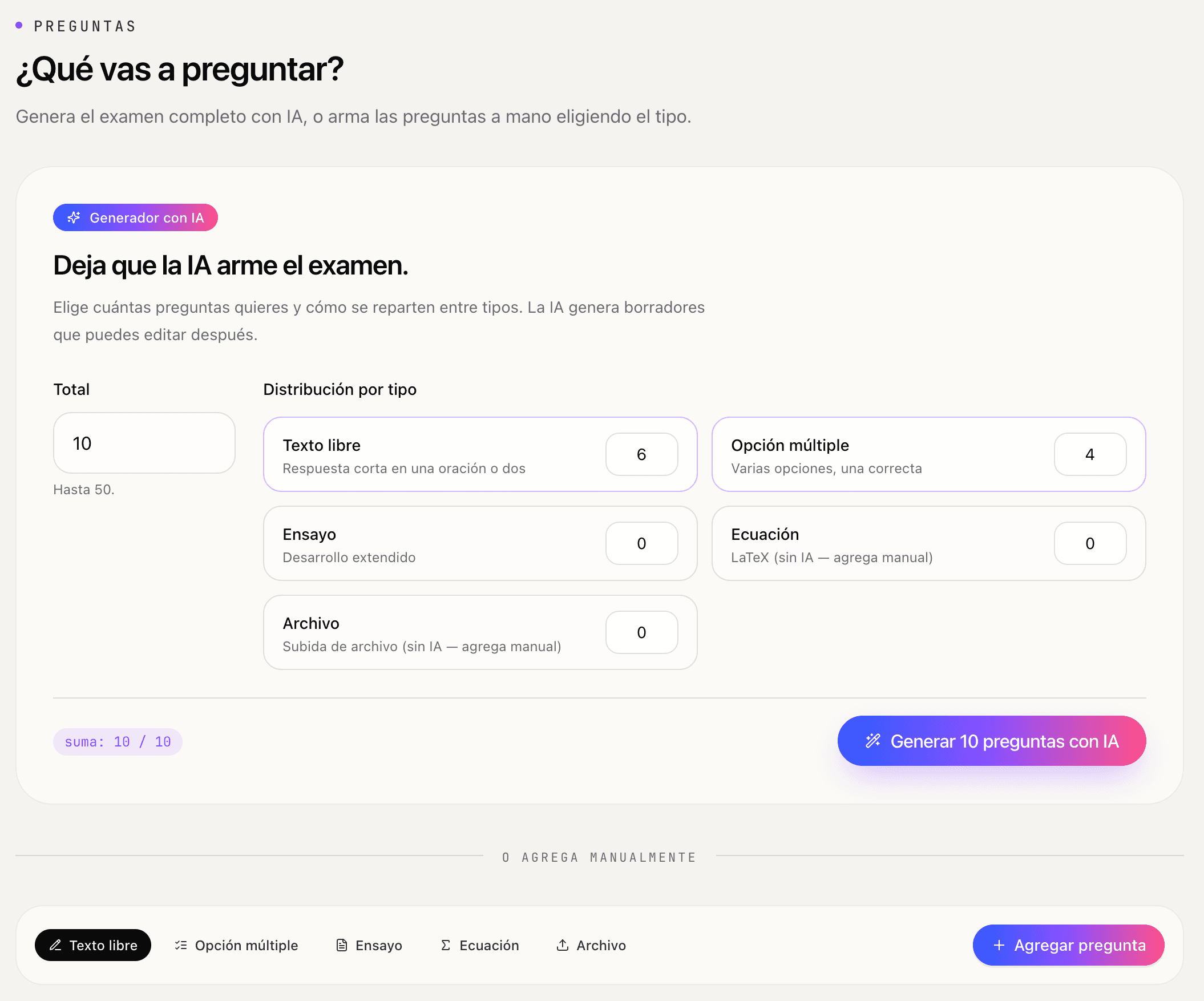
Ten questions in ten seconds.
You choose how many questions and how they split by type: free text, multiple choice, essay, equation, file. AI generates drafts you can edit later — or add your own by hand if you prefer. The balance between speed and control, where you set it.
- 5 types · text, multiple, essay, equation, file
- Custom distribution · edit afterwards
- Manual when you want
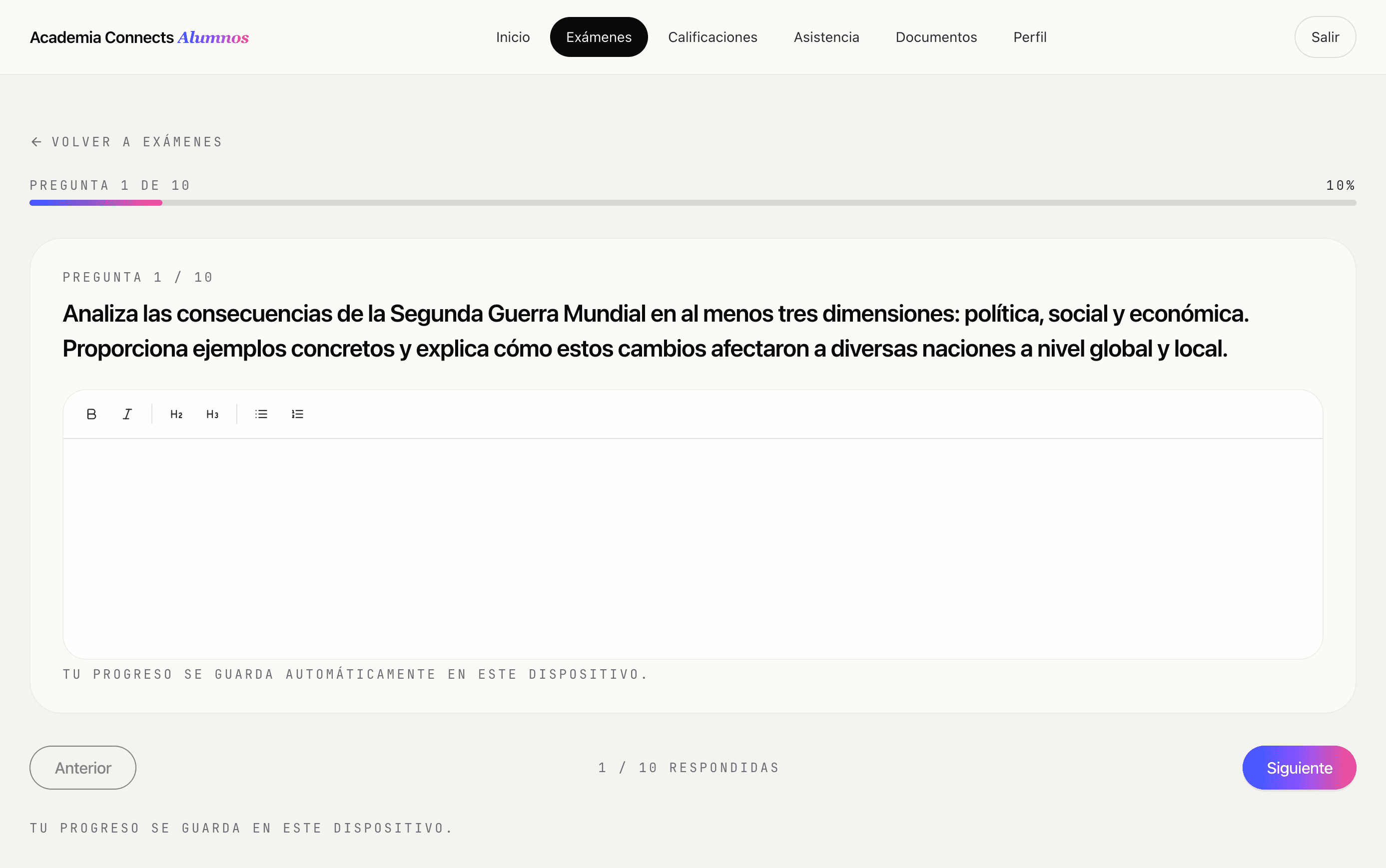
We don't detect AI. We detect when you don't write like you.
Generic AI detectors fail with anyone who writes differently — ESL students, formal writers, anyone who drafts on paper first. We start the other way: every student leaves a writing signature in calibration (rhythm, accents, corrections, sentence-building). During the exam, ten behavioral categories compare against that profile — not against a generic model. Four rounds of adversarial review stress-tested every signal against the false positives that break this class of product. Teachers get priority + breakdown + the why.
- Personal calibration · learns your style
- 10 categories · no single signal decides
- Breakdown + why · teacher decides
AI already won the race. Education isn't ready.
Language models went from academic curiosity to outperforming humans on several benchmarks in under a decade. Schools haven't had time to catch up.
of students use generative AI for assignments and assessments.
HEPI / Kortext 2025 · n=1,041
of undergrads admit to cheating at least once.
McCabe / ICAI 2024
Today we already grade with context and judgment. Tomorrow, project-based learning.
AI · What it can do
In 7 years
2020 · GPT-3
Answers general-knowledge questions with coherence.
2022 · ChatGPT
Coherent conversation. Summarizes, translates, writes full essays.
2023 · GPT-4
Passes the bar exam and the MCAT. Reasons at a professional level.
2024 · Claude 3.5 · o1
Olympiad-level math reasoning. Writes production-grade code.
2025 · Autonomous agents
Execute long tasks. Operate the computer. Run deep research without supervision.
2026 · Agentic era
Autonomous digital coworkers. Run end-to-end workflows with minimal human oversight.
Project-based learning, with virtual teachers.
Tomorrow's schools will host integrative projects — a simulator, a machine, a system — where students apply everything at once: software, electronics, mechanical, robotics. Virtual teachers are agents with specific personalities and skills, available any time.
Nothing taught me those concepts better than an integrative project. This module scales that experience.
Disciplines a project touches
- Software
- Electronics
- Electrical
- Mechanical
- Integration
- Robotics
Module in development · 2026
Book a demo.
Tell us about your institution. We'll reach out within 48 hours.
Committed to education in Mexico and Latin America.
We build products at





3 USPTO patents as inventors
We're engineers who used to teach. We know from the inside where time gets wasted, and where software can give it back.